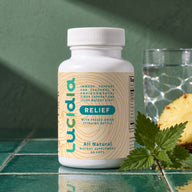

Quercetin and Bromelain Together: Why This Combination Works

Quick answer
Quercetin and bromelain work better together than either does alone. Bromelain improves quercetin's limited oral absorption, and their anti-inflammatory mechanisms are complementary — quercetin stabilizes mast cells before they release histamine, while bromelain clears the inflammatory proteins that accumulate after an immune response.
In This Article
Of the five ingredients in Lucidia, the pairing I spent the most time on was quercetin and bromelain. Not because they are the most complex ingredients individually — but because of what happens when you put them together.
Quercetin is one of the plant allies I reach for most. It is a mast cell stabilizer with decades of research behind it. But it has a real limitation: your gut metabolizes much of it before it reaches your bloodstream. Bromelain — the proteolytic enzyme from pineapple stems — addresses that problem directly. It improves quercetin's absorption. And it does its own work downstream, clearing the inflammatory debris that quercetin helps keep from forming in the first place.
Two compounds. Two stages of the same process. That pairing has been a formulation standard in clinical practice for decades.
How Quercetin Works in the Body
Quercetin stabilizes mast cells and modulates the inflammatory response through at least two documented pathways. It is a plant flavonoid — found in onions, capers, apples, and berries — with thousands of published papers behind it. But the mechanisms that matter most for this combination are specific.
Quercetin stabilizes mast cells by inhibiting the calcium influx that triggers degranulation — the process where mast cells release histamine and other inflammatory mediators. A 2005 study using human mast cells from Tufts University found that quercetin significantly reduced intracellular calcium levels and inhibited the release of histamine, prostaglandin D2, and several inflammatory cytokines including IL-6 and TNF (Kempuraj et al., British Journal of Pharmacology).
It also blocks NF-κB, one of the primary signaling pathways that drives inflammatory cytokine production. In human mast cells, quercetin reduced TNF-α, IL-1β, IL-6, and IL-8 by attenuating NF-κB activation (Kim et al., Inflammation Research, 2007).
What I find most significant: a 2012 study from the same Tufts research group found that quercetin was more effective than cromolyn sodium — the pharmaceutical mast cell stabilizer — at blocking human mast cell cytokine release. The same study included a small human component showing effects on contact dermatitis (Weng et al., PLOS ONE).
The limitation that matters for formulation: quercetin has limited oral bioavailability. A landmark human study measured quercetin absorption and found that a significant portion of an oral dose is metabolized during first-pass through the gut wall and liver before it reaches systemic circulation (Hollman et al., American Journal of Clinical Nutrition, 1995).
This is where bromelain becomes essential.
How Bromelain Works
Bromelain is the cleanup crew — a group of proteolytic enzymes extracted from pineapple stems that address what happens after the immune system has already responded.
Where quercetin helps modulate the immune response upstream, bromelain works at the tissue level. It breaks down fibrin, immune complexes, and kinins — the inflammatory proteins that accumulate at sites of chronic inflammation and keep the cycle going (Maurer, Cellular and Molecular Life Sciences, 2001). Think of it as clearing the debris from a construction site so the tissue can actually rebuild.
Bromelain also modulates inflammatory cytokines through NF-κB and MAPK pathways (Insuan et al., Current Issues in Molecular Biology, 2021), supports lymphatic drainage by breaking down the proteins that trap fluid in inflamed tissue, and has demonstrated anti-inflammatory effects in clinical trials for post-surgical recovery and chronic sinusitis.
One property that distinguishes bromelain: it remains active across a pH range of 3.0 to 8.0, which means it functions in the stomach, the small intestine, and after absorption into the bloodstream.
Why Taking Them Together Is Different
These are not two versions of the same thing. They work at different stages of the inflammatory process, through entirely different mechanisms. Here is what the combination accomplishes that neither can do alone.
Bromelain Improves Quercetin Absorption
This is the most practical reason to pair them. Quercetin's limited bioavailability means that much of an oral dose never reaches the cells where it can stabilize mast cells and modulate inflammation.
Bromelain has a documented ability to enhance the absorption of co-administered compounds — most extensively studied with antibiotics, where bromelain increased tissue concentrations of amoxicillin and tetracycline (Kelly, Alternative Medicine Review, 1996). The proposed mechanism: bromelain's proteolytic activity modifies proteins in the intestinal mucosa, temporarily improving the uptake of molecules that would otherwise be poorly absorbed.
This pairing predates quercetin phytosomes and liposomal delivery systems by decades. It remains the simplest and most cost-effective approach to making quercetin work better orally.
Working Upstream and Downstream
This is the piece that made me pair them in the first place.
Quercetin works upstream — at the mast cell, before degranulation happens. It reduces the amount of histamine and inflammatory mediators released in the first place.
Bromelain works downstream — at the tissue level, after the immune system has responded. Its proteolytic activity breaks down the fibrin, immune complexes, and cytokines that have already been released. It clears the backlog so the tissue can resolve.
In someone dealing with histamine intolerance or chronic immune overreactivity, both stages matter. The mast cells need calming (quercetin), and the accumulated debris from past overreactions needs clearing (bromelain). When we only address one side, the body stays stuck.
This is the formulation logic behind combining them in Lucidia — and it extends to the full five-ingredient system, where NAC supports glutathione production, reishi modulates overall immune balance, and stinging nettle supports the histamine pathway at the receptor level.
Different Anti-Inflammatory Pathways
Both quercetin and bromelain reduce inflammation, but through mechanisms that do not overlap.
Quercetin inhibits calcium-dependent mast cell degranulation, blocks NF-κB signaling in immune cells, suppresses cytokines including TNF-α and IL-6, and modulates histamine release at the source.
Bromelain uses proteolytic breakdown to clear fibrin and inflammatory immune complexes, has fibrinolytic activity that helps dissolve deposits perpetuating inflammation, modifies CD44 surface markers on immune cells, and supports lymphatic drainage by reducing protein-trapped edema.
Because they work through independent pathways, combining them does not mean taking more of the same. It means covering more of the inflammatory cascade.
What the Research Shows
Both compounds have strong individual research bases — and being honest about what has and has not been studied as a combination matters.
Quercetin's mast cell-stabilizing effects have been demonstrated in multiple human cell studies from the Theoharides laboratory at Tufts University, the leading research group on mast cell pharmacology.
Bromelain's anti-inflammatory and fibrinolytic properties have been studied in clinical settings including post-surgical recovery (Braun et al., Evidence-Based Integrative Medicine, 2005), chronic sinusitis (Helms & Miller, Alternative Medicine Review, 2006), and osteoarthritis where a bromelain-containing enzyme formulation performed comparably to diclofenac with fewer GI side effects (Akhtar et al., Clinical Rheumatology, 2004).
The combination has appeared in clinical protocols — notably in a multi-ingredient study combining zinc, quercetin, bromelain, and vitamin C for respiratory support (Ahmed et al., Research Ideas and Outcomes, 2020). However, these were multi-ingredient protocols, and the contribution of the quercetin-bromelain pair cannot be isolated from the other components.
The honest picture: no published randomized controlled trial has tested quercetin plus bromelain as a two-ingredient combination against immune outcomes in humans. The evidence base is strong for each individual compound. The rationale for combining them comes from the complementary mechanisms described above and from decades of practitioner experience with the pairing.
This distinction matters. Some supplement marketing implies the combination has been validated as a unit in controlled trials. What HAS been validated is each compound's individual mechanism — and the mechanistic rationale for combining them is well-established in the literature and in clinical practice.
When and How to Take Quercetin and Bromelain
Take them together, on an empty stomach. That is the single most important detail. Here is why timing matters.
| Goal | Timing | Why |
|---|---|---|
| Systemic anti-inflammatory + mast cell support | Empty stomach (30 min before meals or 2 hrs after) | Allows both compounds to enter systemic circulation |
| Maximum quercetin absorption | Take together with bromelain, between meals | Bromelain's absorption-enhancing effect requires them in the gut simultaneously |
| Digestive support (bromelain only) | With meals | Bromelain works as a digestive enzyme when taken with food |
Typical study doses:
- Quercetin: 500–1,000 mg per day
- Bromelain: 500–2,000 GDU per day
When evaluating bromelain products, look at the GDU (gelatin digesting units) count on the label, not just the milligrams. Two bromelain supplements can have the same weight per capsule but very different enzymatic activity.
Empty stomach is the key detail. When bromelain is taken with food, it gets used up breaking down dietary proteins in the stomach rather than entering the bloodstream where it can enhance quercetin absorption and support systemic anti-inflammatory effects.
Safety: Both are well-tolerated at standard doses. The main precaution is bromelain's mild fibrinolytic (clot-thinning) activity — consult your healthcare provider if you take anticoagulant or antiplatelet medications. Pineapple allergy is a contraindication for bromelain.
The Formulation Principle
What I keep coming back to in formulation is the question of layers. A single compound addresses a single point. A formula can address a system — if the ingredients are chosen to complement each other rather than duplicate the same action.
Quercetin calms the immune response at its source. Bromelain clears what the body could not resolve on its own. And bromelain ensures your body absorbs enough quercetin to make a difference. They are one pairing within a larger system that includes NAC, reishi, and stinging nettle — each addressing a different layer of immune regulation and gut health.
All of these processes run on cellular energy. If ATP regeneration is part of what you are working on, our guide on creatine covers that upstream system.
These statements have not been evaluated by the Food and Drug Administration. This product is not intended to diagnose, treat, cure, or prevent any disease.
References
- Kempuraj, D., Madhappan, B., Christodoulou, S., et al. (2005). Flavonols inhibit proinflammatory mediator release, intracellular calcium ion levels and protein kinase C theta phosphorylation in human mast cells. British Journal of Pharmacology, 145(7), 934–944.
- Kim, S. H., Jun, C. D., Suk, K., et al. (2007). Quercetin inhibits expression of inflammatory cytokines through attenuation of NF-κB and p38 MAPK in HMC-1 human mast cell line. Inflammation Research, 56(5), 210–215.
- Weng, Z., Zhang, B., Asadi, S., et al. (2012). Quercetin is more effective than cromolyn in blocking human mast cell cytokine release and inhibits contact dermatitis and photosensitivity in humans. PLOS ONE, 7(3), e33805.
- Hollman, P. C. H., de Vries, J. H., van Leeuwen, S. D., et al. (1995). Absorption of dietary quercetin glycosides and quercetin in healthy ileostomy volunteers. American Journal of Clinical Nutrition, 62(6), 1276–1282.
- Maurer, H. R. (2001). Bromelain: biochemistry, pharmacology and medical use. Cellular and Molecular Life Sciences, 58(9), 1234–1245.
- Kelly, G. S. (1996). Bromelain: a literature review and discussion of its therapeutic applications. Alternative Medicine Review, 1(4), 243–257.
- Insuan, O., Janchai, P., Thongchuai, B., et al. (2021). Anti-inflammatory effect of pineapple stem bromelain proteases and their role in NF-κB and MAPK pathways. Current Issues in Molecular Biology, 43(3), 1117–1130.
- Braun, J. M., Schneider, B., & Beuth, H. J. (2005). Therapeutic use, efficiency and safety of the proteolytic pineapple enzyme bromelain. Evidence-Based Integrative Medicine, 2(4), 193–200.
- Helms, S., & Miller, A. (2006). Natural treatment of chronic rhinosinusitis. Alternative Medicine Review, 11(3), 196–207.
- Akhtar, N. M., Naseer, R., Farooqi, A. Z., et al. (2004). Oral enzyme combination versus diclofenac in the treatment of osteoarthritis of the knee. Clinical Rheumatology, 23(5), 410–415.
- Ahmed, A., et al. (2020). Quadruple therapy zinc, quercetin, bromelain, and vitamin C. Research Ideas and Outcomes.
Nathalie Babazadeh, L.Ac
Co-Founder & Formulator
18+ years in acupuncture, TCM, and herbalism. Co-formulated Lucidia in 2009 from clinical practice. Co-founder of the REN School of Consciousness.
Continue reading
All histamine articles →-
 Start here
Histamine and immune intelligence: the guide
Every histamine article, in reading order. Nathalie Babazadeh, L.Ac. and Kacey Moe, MS -
 The five ingredients
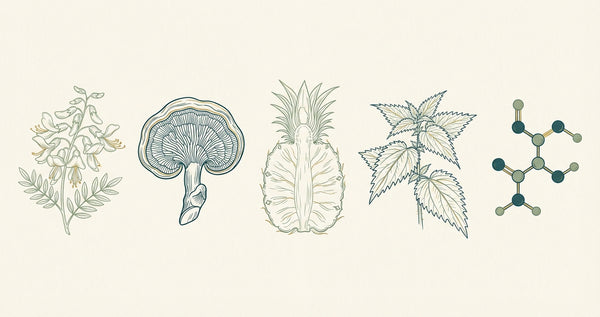
Lucidia Ingredients: The Longevity Science Behind Five Compounds
Nathalie Babazadeh, L.Ac. · 12 min -
 The five ingredients
Stinging Nettle for Allergies and Beyond: What the Research Says
Nathalie Babazadeh, L.Ac. · 7 min
Not sure where to start? Take the 3-minute quiz
Get new articles by email
New articles from Nathalie and Kacey. Unsubscribe anytime.

Lucidia
Daily histamine support, formulated by Nathalie and Kacey in their practice in 2009. Same five ingredients since.
★ 4.3 out of 5 stars from · 238 reviewsQuercetin, NAC, reishi, bromelain, nettle
$29.99Free shipping · 60 capsules
Subscribe and save 10%