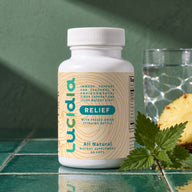

Quercetin vs. Cromolyn for Mast Cell Support: What the Research Shows

Quick answer
Both quercetin and cromolyn stabilize mast cells, but through different mechanisms. A 2012 study found quercetin more effective at inhibiting cytokine release. Quercetin works systemically and is available without a prescription; cromolyn works locally in the gut and requires one.

In This Article
If you are dealing with mast cell activation or histamine intolerance, you have probably encountered both of these names. Cromolyn sodium is the pharmaceutical standard for mast cell stabilization. Quercetin is the natural compound that keeps showing up in practitioner protocols.
They both stabilize mast cells. They do it through different mechanisms, have different accessibility, and come with different trade-offs. Here is what the research actually shows.
What Cromolyn Sodium Does
Cromolyn sodium was developed in the 1960s from a compound found in the plant Ammi visnaga (bishop's weed), which herbalists in the Mediterranean had used for centuries. The pharmaceutical version was initially designed for asthma and later adopted for mast cell disorders.
Cromolyn works primarily by stabilizing chloride channels on the mast cell membrane. When mast cells are about to degranulate, chloride channels open as part of the activation cascade. Cromolyn blocks this channel opening, preventing the cell from completing the degranulation process (Norris, 1996).
Forms available
- Inhaled (Intal): For asthma and respiratory mast cell activation. Largely discontinued in the US but still available in some countries.
- Oral (Gastrocrom): For gastrointestinal mast cell symptoms. Prescription only in the US. Poorly absorbed systemically, which means it works locally in the gut lining.
- Nasal spray (NasalCrom): Over-the-counter in the US. For nasal mast cell symptoms.
- Ophthalmic (Crolom): Eye drops for ocular mast cell symptoms.
Limitations
Cromolyn has low oral bioavailability — only about 1% of oral cromolyn is absorbed into the bloodstream (Norris, 1996). This is actually by design for GI symptoms (you want it working locally in the gut), but it means oral cromolyn does not stabilize mast cells in other tissues like the skin, brain, or respiratory tract.
Cromolyn must be taken 15-20 minutes before meals to be effective for food-triggered symptoms. It requires a prescription for the oral form. And for some patients, the GI side effects (nausea, diarrhea, headache) make consistent use difficult.
What Quercetin Does
Quercetin is a flavonoid found in onions, capers, apples, and berries. It stabilizes mast cells through a different set of mechanisms than cromolyn.
Quercetin inhibits calcium influx into the mast cell. Calcium is required for degranulation — without sufficient intracellular calcium, the granules cannot fuse with the cell membrane and release their contents. Quercetin also inhibits the NF-κB signaling pathway, which reduces the production of pro-inflammatory cytokines like TNF-alpha, IL-6, and IL-8 (Weng et al., 2012).
This is a broader mechanism than cromolyn's. Where cromolyn blocks one channel, quercetin affects multiple upstream signaling pathways.
The 2012 Weng Study
The head-to-head comparison that practitioners reference most often comes from Theoharides' lab at Tufts University. Weng et al. (2012) compared quercetin and cromolyn sodium using human cultured mast cells (HMC-1 cells and primary human umbilical cord-derived mast cells).
The findings:
- Quercetin inhibited cytokine release (IL-6, IL-8, TNF-alpha) more effectively than cromolyn at equivalent concentrations Strong evidence
- Quercetin reduced intracellular calcium levels in activated mast cells
- Quercetin inhibited NF-κB activation, a pathway cromolyn does not directly target
- Quercetin inhibited cytokine gene expression at the mRNA level, not just at the protein release level
This last point matters. Cromolyn prevents mast cells from releasing mediators they have already produced. Quercetin also reduces the production of those mediators in the first place. It works further upstream.
The study was in vitro (cell cultures, not human trials), which is an important caveat. But it remains the most direct comparison available, and the mechanistic data is consistent with what practitioners observe clinically.
Side-by-Side Comparison
Comparison
Quercetin
- Blocks calcium influx + NF-κB signaling
- Works systemically (absorbed into bloodstream)
- No prescription required
- $15-30/month
- Additional senolytic and cardiovascular benefits
Cromolyn
- Stabilizes chloride channels
- Works locally (gut lining for oral form)
- Prescription required (US)
- $200-600/month
- No additional benefits beyond mast cell stabilization
| Factor | Quercetin | Cromolyn Sodium |
|---|---|---|
| Mechanism | Calcium influx inhibition, NF-κB blockade, cytokine gene suppression | Chloride channel stabilization |
| Where it works | Systemic (absorbed into bloodstream) | Primarily local (gut lining for oral form) |
| Cytokine inhibition | IL-6, IL-8, TNF-alpha, tryptase | Primarily histamine, some tryptase |
| Prescription required | No | Yes (oral form in the US) |
| Side effects | Minimal at standard doses; rare headache or GI upset | Headache, nausea, diarrhea in some patients |
| Onset | 1-2 weeks for noticeable effect | Minutes to hours (local effect) |
| Bioavailability challenge | Poor oral absorption (improved with bromelain) | ~1% oral absorption (by design for gut) |
| Cost (approximate) | $15-30/month (supplement) | $200-600/month (Gastrocrom, varies by pharmacy and insurance) |
| Additional benefits | Senolytic, antioxidant, cardiovascular | None beyond mast cell stabilization |
| Research depth | Extensive in vitro, growing clinical | Decades of clinical use, FDA-approved |
The Bioavailability Problem (and How to Solve It)
Both quercetin and cromolyn have bioavailability challenges, though for different reasons.
Cromolyn's low absorption is intentional for GI applications. For mast cell problems outside the gut, you need different forms (inhaled, nasal, ophthalmic) to deliver the drug where it is needed.
Quercetin's bioavailability issue is a formulation challenge. Raw quercetin has poor water solubility and is largely metabolized in the gut before reaching systemic circulation. Several approaches improve this:
Bromelain pairing: The proteolytic enzyme bromelain improves quercetin absorption and adds its own anti-inflammatory properties. This is the approach we use in Lucidia and is the most established combination in practitioner protocols.
Quercetin phytosome: Quercetin bound to phospholipids for improved absorption. Some brands use this technology. More expensive, and the clinical data on phytosomal quercetin for mast cell stabilization specifically is still limited.
Quercetin dihydrate vs. anhydrous: The dihydrate form has slightly better solubility. Most supplements do not specify which form they use.
What Practitioners Do in Practice
In the mast cell activation community, many practitioners layer both quercetin and cromolyn rather than choosing one or the other.
A common approach: quercetin daily as a systemic mast cell stabilizer (addressing mast cells throughout the body), with cromolyn added specifically for GI symptoms if dietary triggers remain a problem despite the quercetin.
For patients who cannot access or tolerate cromolyn (cost, side effects, or prescription barriers), quercetin with bromelain becomes the primary mast cell stabilizer. This is the situation most people find themselves in, and it is where the quercetin research is most reassuring.
For people who are not dealing with clinical MCAS but want general mast cell and histamine support — reducing overreactivity, supporting immune balance, clearing histamine more efficiently — quercetin is the more practical first-line option. It is accessible without a prescription, well-tolerated, and provides benefits beyond mast cell stabilization including cardiovascular and senolytic effects.
Key takeaway
Cromolyn blocks mast cell mediator release. Quercetin also blocks release AND reduces mediator production at the gene expression level. It works further upstream.
The Bottom Line
Cromolyn has decades of clinical use behind it, FDA approval, and a well-understood mechanism. It is the pharmaceutical standard for a reason.
Quercetin works through broader mechanisms, is accessible without a prescription, costs less, and provides additional health benefits beyond mast cell stabilization. The Weng et al. data suggests it may be more effective at the cytokine level, though more human clinical trials comparing the two are needed.
They are not mutually exclusive. If you have access to both and your practitioner recommends it, the combination addresses mast cell activation through complementary pathways.
If you are choosing one, quercetin (particularly paired with bromelain for absorption) is the more practical starting point for most people. It is what we built Lucidia around, and it is what practitioners recommend as the foundation of mast cell support.
Shop Lucidia — quercetin + bromelain + NAC + reishi + stinging nettles. Same five ingredients since 2009.
These statements have not been evaluated by the Food and Drug Administration. This product is not intended to diagnose, treat, cure, or prevent any disease.
References
- Weng, Z., et al. (2012). Quercetin is more effective than cromolyn in blocking human mast cell cytokine release. PLoS ONE, 7(3), e33805.
- Norris, A. A. (1996). Pharmacology of sodium cromoglycate. Clinical & Experimental Allergy, 26(s4), 5-7.
- Theoharides, T. C., et al. (2019). Mast cells, brain inflammation, and autism. European Journal of Pharmacology, 778, 96-102.
Co-Founder & Wellness Director
MS Holistic Nutrition, BS Kinesiology. Specializes in functional nutrition, somatic practice, and women’s health. Co-founder of the REN School of Consciousness.
Continue reading
All histamine articles →-
 Start here
Histamine and immune intelligence: the guide
Every histamine article, in reading order. Nathalie Babazadeh, L.Ac. and Kacey Moe, MS -
 The five ingredients
Bromelain: The Inflammation-Clearing Enzyme You're Probably Missing
Artemis Therapeutics · 7 min -
 Methylation and detox
What Is NAC? The Overlooked Compound Behind Cellular Defense
Kacey Moe, MS · 8 min
Not sure where to start? Take the 3-minute quiz
Get new articles by email
New articles from Nathalie and Kacey. Unsubscribe anytime.

Lucidia
Daily histamine support, formulated by Nathalie and Kacey in their practice in 2009. Same five ingredients since.
★ 4.3 out of 5 stars from · 238 reviewsQuercetin, NAC, reishi, bromelain, nettle
$29.99Free shipping · 60 capsules
Subscribe and save 10%