Stress and pollen trigger the same mast cells. When your sympathetic nervous system fires — from anxiety, overwhelm, or chronic stress — those cells release histamine, the same way they do during an allergic reaction. Calming the nervous system back to parasympathetic mode often quiets symptoms within minutes.
Histamine isn't just an allergy problem. It's not just seasonal, environmental, or even dietary. Histamine is directly connected to a nervous system trigger.
This article is to offer you a mini health challenge — and self experiment. Want to find out if you can calm your symptoms in five minutes?
I created a 5-minute Qi Gong practice to regulate the nervous system and work with histamine symptoms directly. Try it. But first — here's how it works.
In This Article
How Stress and the Nervous System Trigger Histamine Reactions
Stress activates the sympathetic nervous system — fight-or-flight mode. Your body reads stress (emotional, physical, environmental) as a threat signal. This can be an immediate or chronic low-grade stress. Sometimes it's based in neurochemical levels — cortisol, serotonin, dopamine, epinephrine.
Sympathetic activation triggers mast cells — the immune cells that store and release histamine. When the sympathetic branch fires, mast cells get the signal to degranulate — to open and release their contents into surrounding tissue.
Histamine is one of those contents that gets released. This is why stress makes allergies worse, and why learning how to shift back to parasympathetic can calm symptoms immediately.
They also release inflammatory cytokines, causing inflammation in different parts of the body, depending on the person — such as the brain (brain fog!), skin, gut, joints, or face.
How to Stop This: Direct Access to the Nervous System
Somatic Sensing is instant access to the nervous system. I would argue that it might be faster than any drug or alcohol because even those are sort of "forcing" us to "feel into our bodies." With a bit of practice, we learn what it feels like to switch from living in the mind, to sensing our bodies from the inside out. Both are important. We can switch back and forth, in seconds. The 5-minute Qi Gong practice will train you to somatically sense the vital life force energies in your body and affect real change.
The vagus nerve is the off switch. The vagus runs from your brainstem through your neck, chest, and gut. When it's carrying a strong parasympathetic signal, it tells mast cells to stand down. It dials back inflammatory signaling throughout the body. When stress is triggered, the neck (root of this nerve) gets tight, and for some, blood pressure goes up or pressure in the face floods (allergies). When it relaxes, the blood and fluids can flow back down, and travel each way as needed.
Long slow breathing literally shifts us into low gear — shifts us from sympathetic to parasympathetic. The pace of the breath sets the pace for the rest.
Neurochemistry follows. Cortisol and adrenaline drop. Histamine release slows. The acute reaction loses momentum and seals up.
You Don't Need to Be a Monk
We've seen that experienced meditators can do things that seem physiologically impossible. Lower heart rate on command. Reduce blood pressure. Regulate immune response through breath and attention alone.
This used to be something that required extraordinary dedication and skill.
But I can tell you now that you no longer need to be a monk to be able to calm your systems with your mind and breath. The monks were learning to influence the autonomic nervous system — the systems of the body we consider "involuntary." We now know that these systems can run without needing our attention — but we can manually shift them once we learn how. These are simple tools that are built into all of us: breath, vision, and focused attention.
Ready to Try It? The 5-Minute Challenge
You'll need 5–10 minutes and a quiet spot to sit or lay down in stillness.
I created this specifically to calm a histamine response, but it can be used to simply calm low-grade anxiety, or to get centered if you're feeling scattered.
It's Qi Gong, which means it draws on the powers of the natural world to bring vitality into your body and cells — like breathing brings oxygen into our cells.
You might find that you're able to calm things down in 1 try, or it might take a few, but each practice builds your abilities and is cumulative. Like training for tennis or most things we put time into learning.
This can also help you understand what the main contributing factors are that cause allergies or histamine. For each person it's different — the main contributing factors are exposure to allergens, nervous system / stress / neurochemistry, diet / gut, hormones, and immune system.
The practice addresses the trigger. If your histamine load is already elevated — from diet, environment, or accumulated stress — it also helps to support clearance at the cellular level.
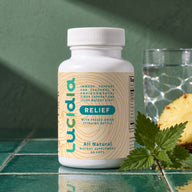
Quercetin, one of Lucidia's five ingredients, stabilizes mast cells directly — the same cells the nervous system either primes or calms depending on which branch is active. The two approaches work on different levels of the same system.



 Start here
 TCM and practices
 TCM and practices
