Autumn is a good season for this topic. In Chinese medicine, autumn belongs to the Lung and to the Metal element, and its theme is letting go. Trees drop what they no longer need, so they can rest and grow back stronger.
Our cells have a version of this, and it can get stuck. Some cells stop dividing, yet they never leave. Researchers call them senescent cells, or zombie cells. Quercetin is studied as a senolytic, a compound that helps clear these zombie cells, and that research is one of the most interesting threads in longevity science right now.
What Is a Senescent Cell?
A senescent cell has stopped dividing in response to damage or stress, but it resists the normal self-destruct program that would clear it away. On its own, that pause is protective. It stops a damaged cell from copying itself.
The trouble starts when these cells accumulate. Senescent cells release a mix of inflammatory messengers known as the SASP, the senescence-associated secretory phenotype. It includes interleukins such as IL-6 and IL-1α, plus enzymes called matrix metalloproteinases (MMPs) that break down the structure around cells.
One zombie cell is a small problem. Many of them, sending out the same signals for months, keep the surrounding tissue in low-grade alarm. This is part of what researchers mean by "inflammaging": the slow inflammatory drift of an aging body.
Our cofounder Nathalie Babazadeh, L.Ac., put it this way in her guide to Lucidia's ingredients: clearing these cells "directly increases vitality, and reduces zombie-like living that is sometimes accepted as a natural part of aging."
How Quercetin Works as a Senolytic
Quercetin interferes with the survival networks that senescent cells rely on, so that damaged cells can finally undergo programmed cell death while healthy cells are left alone.
The discovery came from the Mayo Clinic in 2015. Researchers noticed that senescent cells switch on pro-survival pathways, including a protein called BCL-xL, to protect themselves from their own self-destruct signals. They then looked for compounds that could disable those defenses. Of 46 agents tested, dasatinib and quercetin stood out (Zhu et al., Aging Cell, 2015). Quercetin was the more effective of the two against senescent human endothelial cells, the cells that line our blood vessels. Together, the pair reduced senescent cell burden in aged mice and improved cardiac and vascular function after a single dose.
The human evidence came next:
-
2019, first proof in people. In a small Phase 1 pilot, nine adults with diabetic kidney disease took dasatinib plus quercetin for just three days. Eleven days later, senescent cells in fat and skin tissue had dropped, and so had circulating SASP factors, including IL-1α, IL-6, MMP-9 and MMP-12 (Hickson et al., EBioMedicine, 2019).
-
2025, the STAMINA trial. In a 12-week pilot with older adults, intermittent dasatinib plus quercetin was safe and feasible, with early hints of benefit that now need a larger, controlled trial (Millar et al., eBioMedicine, 2025).
Here is what the research does not show yet. Nearly every human senolytic trial pairs quercetin with dasatinib, a prescription drug. Quercetin's solo senolytic effect is well documented in cells, but in people it is still an open question. And among plant flavonoids, fisetin was the most potent senolytic in a 2018 screen (Yousefzadeh et al., EBioMedicine).
One idea from this research is worth knowing. Senolytics seem to work in a "hit-and-run" way. The Mayo team noted that new senescent cells take more than two weeks to form, so a short course can keep the burden low for days to weeks afterwards.
Zombie Cells and the Airways
Senescent cells do not only gather in aging fat tissue and blood vessels. A growing body of research finds them in the tissues that meet the outside world first: the airways and the sinuses.
Three findings stand out:
-
Asthma research has turned toward senescence. A 2023 review in EBioMedicine described how the triggers of airway inflammation, including oxidative stress and DNA damage, push airway cells into senescence. Asthma affects nearly 10% of people worldwide.
-
The SASP shows up in airway tissue and nasal polyps. In a 2026 analysis of the European U-BIOPRED cohort published in Allergy, SASP gene activity was higher in the bronchial tissue of people with severe asthma. It was also higher in nasal samples from people with nasal polyps. The senescent cells seem to sit mostly in deeper structural tissue, not just the surface lining.
-
Clearing senescent cells lowered type 2 signals. In a 2025 study, airway lining cells from people with COPD were treated with dasatinib plus quercetin. Senescence markers fell, and so did IL-33 and other Th2-type immune signals. Those are the same signals that drive the allergic side of the immune system.
The relationship runs in both directions. Ongoing type 2 inflammation can itself speed up the aging of immune cells, and aging tissue in turn sends out more inflammatory signals.
So Is Senolytic Action Why Quercetin Helps in Allergy Season?
It may be part of the story, but it is not the proven part yet. The established reason quercetin matters during allergy season is its effect on mast cells. Its senolytic activity is a plausible second layer that works on a much longer timescale.
The mast cell evidence is direct. Mast cells are the immune cells that release histamine when pollen lands on the lining of the nose. In a 2012 study in PLoS ONE, quercetin inhibited histamine release from human mast cells and was more effective than cromolyn, the standard pharmaceutical mast cell stabilizer, at blocking the inflammatory messengers IL-8 and TNF. It also worked when given ahead of the trigger, while cromolyn lost its effect unless it arrived at the same moment. We compare the two in detail in Quercetin vs. Cromolyn.
Put the two lines of research side by side and a picture forms:
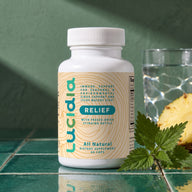
Both lines of research explain why quercetin has a place in Lucidia. Lucidia uses quercetin dihydrate from the flowers of Sophora japonica, alongside NAC, reishi, bromelain and stinging nettle.
The senolytic link is a hypothesis worth taking seriously. A slow shift in the terrain would explain why seasonal patterns can change over years rather than weeks. It still needs to be tested in people.
Where Quercetin Comes From
Quercetin is in many everyday plants. Capers, red onions, apples with the skin, kale, berries and green tea are among the richest food sources.
Absorption and Pairing
Quercetin's main limitation is absorption. Quercetin on its own is poorly absorbed, and the 2012 mast cell researchers noted that its promise depends on formulations that improve oral absorption. Form matters, and so does pairing. Bromelain, the enzyme from pineapple stems, is often combined with quercetin. We explain why in Quercetin and Bromelain Together.
For the wider picture of what quercetin does for the heart and vessels, read Quercetin Benefits. For how it compares with another longevity flavonoid, see Quercetin vs. Resveratrol.
As always, talk with your practitioner before starting a new supplement, especially if you take prescription medication.
Key takeaway
Quercetin was one of the first senolytics ever found, and a human pilot showed that a short course of quercetin plus dasatinib lowered senescent cell burden and inflammatory signals. Senescent cells also build up in airway and sinus tissue. Mast cell support remains quercetin's best-proven role in allergy season; its senolytic side may shape the terrain over years.
Sources: Zhu et al., Aging Cell 2015 · Hickson et al., EBioMedicine 2019 · Millar et al., eBioMedicine 2025 · Weng et al., PLoS ONE 2012 · U-BIOPRED, Allergy 2026
These statements have not been evaluated by the Food and Drug Administration. This product is not intended to diagnose, treat, cure, or prevent any disease.



 Start here
 Histamine and mast cells
 TCM and practices
