Every March, something shifts.
Maybe it's the brain fog that appeared overnight. The skin that's suddenly reactive to things that didn't bother you in January. The glass of wine that now gives you a headache when it never used to. Or the congestion that has nothing to do with being sick.
This isn't random. Your histamine system is responding to a real change in its environment — and it's doing exactly what it was designed to do.
Your Mast Cells Are Not Malfunctioning
The thing most people don't realize about spring symptoms is that they're not a sign something is broken.
Mast cells are immune sentinels. They live in every tissue that contacts the outside world — your skin, your gut lining, your respiratory tract. When they detect a potential threat, they degranulate — releasing histamine and other mediators as a first-response signal. Learn more in our guide to histamine and gut health.
In winter, environmental inputs are low. Your mast cells are relatively quiet. Your body clears histamine at a pace that matches the load.
Then spring arrives. Pollen counts rise. Mold spores increase. Temperature swings trigger immune recalibration. Your mast cells start firing more frequently — not because they're overreacting, but because they're responding to a higher environmental load.
The question isn't whether your mast cells will respond. It's whether your body can keep up with the clearance.
The Bucket — and Why It Overflows in March
Think of your histamine capacity as a bucket.
Every source of histamine — food, environment, gut bacteria, stress hormones, even your menstrual cycle — adds to the bucket. Two enzymes do most of the emptying: DAO (diamine oxidase) in the gut, and HNMT (histamine N-methyltransferase) inside cells. Your liver handles the rest through methylation and Phase II detoxification.
In winter, the bucket drains faster than it fills. You feel fine. You eat aged cheese and drink red wine and nothing happens.
In spring, the environmental inputs surge. The bucket starts filling faster. If your clearance enzymes can't keep pace — because of genetics, gut health, liver load, sleep quality, or stress — the bucket overflows.
That overflow is what you experience as symptoms: brain fog, skin reactivity, headaches, sinus pressure, fatigue, disrupted sleep. Not because you're sick. Because your capacity was exceeded.
Three Systems That Determine Your Spring
In practice, I notice that spring histamine isn't just about mast cells. It's about three systems working together — or failing to.
1. Mast Cell Stability
How easily your mast cells degranulate determines how much histamine enters the bucket in the first place. Some people have mast cells that are hair-trigger sensitive. Others are more stable. This is partly genetic, partly influenced by inflammation, gut health, and prior immune activation.
Quercetin — the flavonoid found in onions, apples, and Sophora japonica flowers — is one of the few natural compounds shown to stabilize mast cell membranes. It doesn't suppress the immune response. It helps the response stay proportional.
2. Liver Clearance
Your liver is the final processing station for histamine. It relies on methylation (via HNMT) and Phase II conjugation pathways to break histamine down and clear it from circulation.
When the liver is overburdened — from alcohol, medications, environmental toxins, poor sleep — histamine clearance slows. The bucket fills faster not because you're producing more, but because you're clearing less.
NAC (N-Acetyl Cysteine) is a direct precursor to glutathione, the molecule your liver depends on for detoxification. Feeding glutathione production is one of the most direct ways to increase histamine clearance capacity.
3. Immune Calibration
Your immune system needs to distinguish between a genuine threat and background noise. In spring, the sheer volume of environmental inputs can overwhelm this calibration.
Reishi mushroom is an immunomodulator — not a stimulant. Its beta-glucans help immune cells calibrate their response rather than simply amplifying it. In a 2023 randomized controlled trial, reishi beta-glucan supplementation significantly increased natural killer cell activity while improving overall immune balance (Chen et al., Foods). Stronger response when needed, quieter response when not. That's modulation.
What Actually Helps
The conventional approach is to block histamine after it's released. That works in the moment. It does nothing about why the bucket is overflowing.
What I see work better — consistently, year after year — is supporting the systems upstream. Stabilize mast cells so they respond proportionally. Support the liver so it clears histamine efficiently. Help the immune system calibrate.
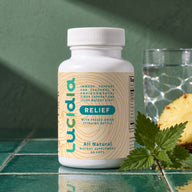
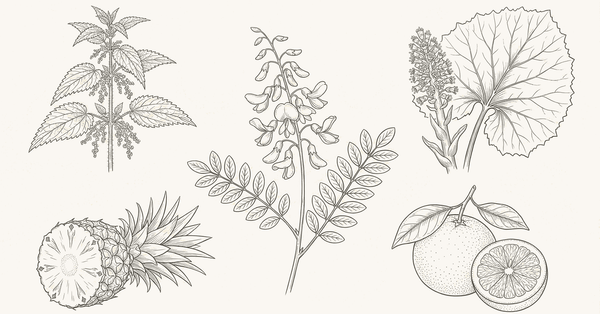
Quercetin and stinging nettle work at the mast cell level. NAC feeds glutathione production for liver clearance. Reishi modulates the immune response. These are the five ingredients in Lucidia, and they were chosen specifically because they support these three pathways together. Not suppression. Support.
The Timing Matters
One pattern I notice every spring in practice: people wait until symptoms peak before they start supporting their histamine pathways. By then, the bucket is already overflowing.
Start early. Before pollen season peaks in your area. Late February or early March, maintained through May. Two weeks is usually enough to notice a difference in baseline reactivity — not because the pollen count dropped, but because your clearance capacity caught up with the load. Learn more in our guide to allergy seasons are getting longer.
A Note on Food
Your diet is filling the bucket too. During spring, histamine-rich foods stack on top of environmental load:
- Aged cheeses, cured meats, fermented foods
- Red wine, beer, champagne
- Canned fish, smoked salmon
- Vinegar-based dressings
- Leftover proteins (histamine increases as cooked protein sits)
This doesn't mean you need to eliminate everything. It means being aware that in spring, your margin for dietary histamine is narrower. Some people find that simply reducing high-histamine foods during peak season is enough to keep the bucket below the overflow point.
The Bigger Frame
Spring histamine isn't a disease. It's a signal that your body's capacity is being tested by its environment.
The body already knows how to handle histamine. It has enzymes for it, pathways for it, an entire system designed for it. We just need to support that system through the season when it's working hardest.
These statements have not been evaluated by the Food and Drug Administration. This product is not intended to diagnose, treat, cure, or prevent any disease.



 Start here
 Histamine and mast cells
 Histamine and mast cells
